





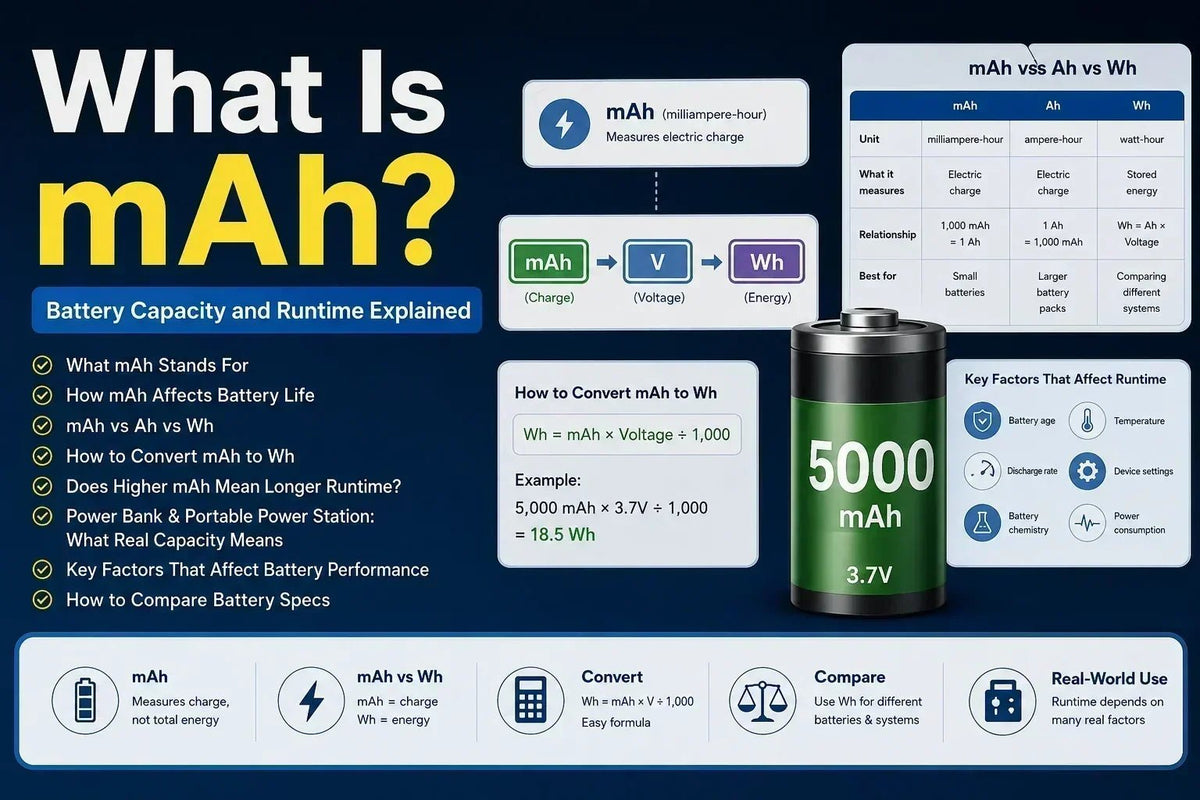
What is mAh? The abbreviation stands for milliampere-hour, a unit that measures how much electric charge a battery can store. You will often see mAh on phones, earbuds, cameras, rechargeable batteries, and power banks.
A higher mAh rating usually means longer battery life when comparing batteries with the same voltage. However, mAh does not measure the total energy a battery stores. Battery voltage, chemistry, power consumption, temperature, and age also affect runtime. When comparing larger battery packs or portable power stations, watt-hours provide a more useful measurement.

mAh Meaning: What Does mAh Stand For?
The mAh meaning becomes clearer when you separate the abbreviation into two parts:
- mA means milliampere, or one-thousandth of an ampere.
- h means hour.
Together, milliampere-hour (mAh) measures electric charge over time. A milliampere measures current, while the hour represents how long that current flows.
A 1,000 mAh battery could theoretically supply:
- 1,000 milliamps for one hour
- 500 milliamps for two hours
- 100 milliamps for ten hours
These are ideal examples. Actual battery runtime may be shorter because the current required to power a device can change during use.
The National Institute of Standards and Technology states that one ampere-hour equals 3,600 coulombs. Therefore, one mAh equals 3.6 coulombs of electric charge.
How Does mAh Affect Battery Life?
You can estimate mAh battery life when you know the battery capacity and the device’s average current draw:
Estimated runtime in hours = battery capacity in mAh ÷ current draw in mA
For example, divide a 5,000 mAh battery by a steady 500 mA load. The ideal runtime is ten hours.
Real devices rarely draw a steady current. A phone may use more power during gaming, navigation, video recording, or mobile data use. Its power consumption usually falls when the screen is off.
Other factors also affect how batteries perform:
- Battery age
- Battery chemistry
- Temperature
- Discharge rate
- Device settings
- Internal power conversion
- Battery management limits
Use the runtime formula as an estimate rather than a guarantee.

Does Higher mAh Mean Longer Battery Life?
A higher mAh rating generally means the battery can store more electric charge. It often provides longer battery life when both batteries use the same voltage and power the same device.
For example, a compatible 5,000 mAh battery will usually last longer than a 3,000 mAh battery. You cannot make the same comparison when battery voltage differs.
Different types of batteries also behave differently. A lithium-ion battery and a lead-acid battery may have different voltages, discharge characteristics, and intended uses. Their mAh ratings alone do not provide a complete comparison.
A higher mAh rating also does not tell you:
- How quickly the battery charges
- How much power it can deliver at once
- How many charge cycles it can provide
- Whether it uses higher-quality cells
- Whether it is compatible with your device
mAh vs Ah: What Is the Difference?
Milliampere-hours and ampere-hours measure the same property: electric charge.
1,000 mAh = 1 ampere-hour (Ah)
Manufacturers usually use mAh for smaller batteries and Ah for larger battery packs. A phone battery may show 5,000 mAh, while a larger battery may display 5 Ah. These two ratings represent the same amount of charge if the batteries operate at the same voltage.
Changing from mAh to Ah only changes the scale of the number. It does not change the battery’s actual capacity.
mAh vs Wh: Which Measurement Is More Useful?
The main difference between mAh vs Wh is what each unit measures:
- mAh measures electric charge.
- Wh measures stored energy.
A watt-hour (Wh) includes voltage, so it gives a clearer picture of the amount of energy a battery stores.
Two batteries can have the same mAh rating but different Wh ratings. The battery with the higher voltage stores more energy, even though both show the same mAh capacity.
This is why mAh works best when comparing similar batteries at the same voltage. Use watt-hours when comparing different battery designs, power banks, solar generators, or portable power stations.

How to Convert mAh to Wh
Use this formula to convert mAh to Wh:
Wh = mAh × battery voltage ÷ 1,000
For example, a 5,000 mAh battery operating at 3.7V stores approximately:
5,000 × 3.7 ÷ 1,000 = 18.5 Wh
A 10,000 mAh battery at 3.7V stores:
10,000 × 3.7 ÷ 1,000 = 37 Wh
A 5,000 mAh battery operating at 7.4V also stores 37 Wh. Although it has half the mAh rating, its higher voltage gives it the same calculated energy.
The Federal Aviation Administration uses the same conversion method. Divide mAh by 1,000 to obtain Ah, then multiply Ah by voltage to calculate Wh.

How Should You Compare Power Bank Capacity?
Power bank capacity appears in mAh, but manufacturers may base it on the internal cells. It may not match the USB output.
For example, a 10,000 mAh power bank does not always charge a 5,000 mAh phone battery exactly twice. The power bank’s internal battery may operate at one voltage while its USB output uses another. Voltage conversion, cable resistance, charging circuits, and heat all consume some energy.
For a better comparison:
- Check the power bank’s mAh rating.
- Find its internal battery voltage.
- Convert the rating to Wh.
- Compare the Wh rating with the phone battery.
- Allow for conversion and charging losses.
Watt-hours provide a more accurate comparison because they include voltage.
Does mAh Determine Charging Speed?
No. mAh measures battery capacity, not charging speed.
Charging time depends on:
- Charger power
- Battery input limit
- Charging voltage
- Battery temperature
- Battery management settings
- Charging losses
A larger battery may take longer to charge when two batteries use the same charger. Fast-charging support can reduce the charging time, but the mAh rating alone cannot tell you how quickly charging will finish.
Why Portable Power Station Capacity Uses Wh
Manufacturers usually show portable power station capacity in Wh or kWh. This is because these systems use larger battery packs. They can also have different internal voltages. Watt-hours make it easier to compare their total stored energy.
Three ratings matter when choosing portable power stations or solar generators:
- Wh measures stored energy: It helps estimate runtime.
- W measures continuous output: It shows the amount of power the inverter can deliver.
- Surge watts measure startup power: They matter for motors, pumps, and compressors.
A system with more Wh may run appliances longer, but it still needs enough output power to operate them. A large battery pack cannot compensate for an inverter that is too small.
Solar panels can recharge a portable power station, but panel wattage does not change its battery capacity. It only affects how much charging power may be available under suitable conditions.
ABOK’s portable power station buying guide explains how watt-hour capacity and power output work together.
How to Compare Battery Specifications
Use this process when reviewing battery specifications:
- Find the mAh or Ah rating.
- Check the nominal battery voltage.
- Calculate Wh if the label does not provide it.
- Compare mAh only when voltage is the same.
- Check power output separately from capacity.
- Review battery chemistry and charge-cycle information.
- Confirm voltage, connector, size, and device compatibility.
For phones and similar devices, mAh provides a useful comparison when the batteries use the same voltage. For power banks, backup batteries, portable power stations, and solar generators, Wh gives a clearer picture of stored energy.
Look Beyond the mAh Number
mAh measures electric charge, not total energy, charging speed, or output power. A higher mAh rating usually suggests longer runtime when battery voltage and operating conditions are similar.
When voltage differs, convert mAh to watt-hours before comparing batteries. Use Wh to understand stored energy and W to understand output power. Reading these battery specifications together gives a clearer view of the battery’s energy.
It shows what the battery can power and how long it may last.
Share:
What Is mAh? A Simple Guide to Battery Capacity
How Much Does a Generator Cost? A Practical 2026 Price Guide